Commercial roofing for warehouses, distribution centers, and industrial facilities throughout Knoxville, TN. TPO, EPDM, and metal roof systems.
Pilot Flying J, headquartered in Knoxville and operating one of North America's largest travel center and distribution networks, maintains substantial logistics and parts fulfillment operations in the Knoxville metro area. The region's industrial base, which includes a growing cluster of automotive-sector suppliers serving the nearby Chattanooga and BMW corridors along with established distribution operations serving the Appalachian Southeast, has created a steady market for commercial roofing services on distribution buildings ranging from 50,000 to over 500,000 square feet. Knoxville's climate — humid subtropical with warm summers, moderate winters, and significant orographic rainfall from the surrounding mountains — creates a distinctive roofing environment that rewards local expertise.
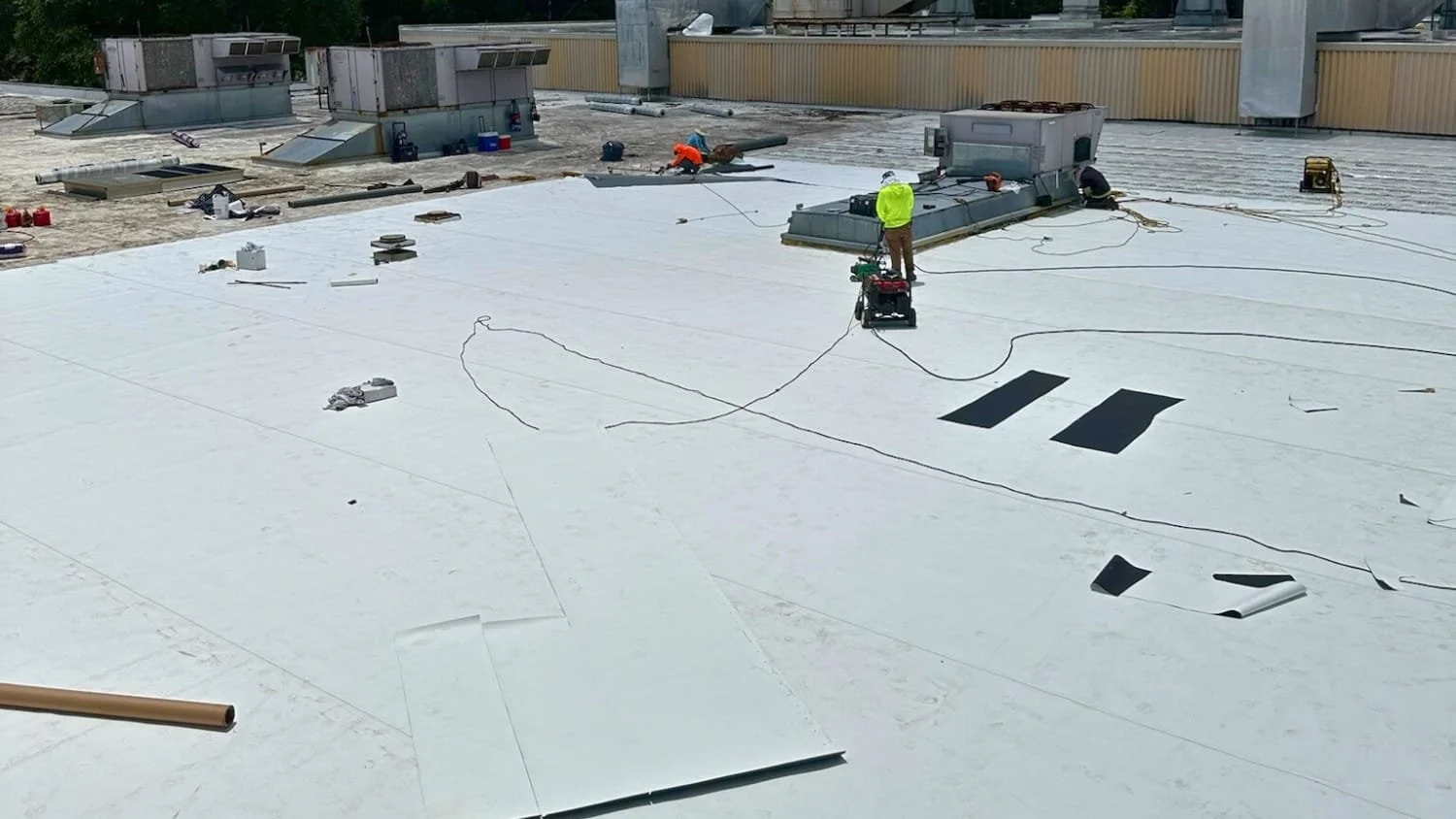
Knoxville's position in the Tennessee Valley means that it receives more annual rainfall than most comparable Southern cities, often exceeding 47 inches per year, driven by moisture wrapping around the Appalachian ridges and delivering sustained rainfall events that can last multiple days. TPO membranes in 60- to 80-mil thickness are the standard for new Knoxville warehouse construction, selected for their reflective performance in the region's warm summers and for the watertightness of their heat-welded seam system, which provides superior resistance to the sustained moisture exposure that characterizes East Tennessee's climate compared to systems with adhesive-bonded lap seams.
Drainage engineering for Knoxville warehouse roofs must account for both the high annual rainfall volume and the intense convective events that the region experiences during spring and summer, when NOAA data shows 100-year 1-hour intensities approaching 3 inches. The mountain topography that surrounds Knoxville can also cause localized orographic enhancement of rainfall totals during certain storm track orientations, meaning that a storm that delivers average rainfall at McGhee Tyson Airport can produce significantly higher totals at nearby industrial buildings depending on their position relative to ridgelines. Properly designed primary and secondary drainage sized to conservative local data is essential, supplemented by tapered insulation systems that eliminate flat spots where ponding might otherwise develop.
Dock door and truck court flashing on Knoxville's tilt-up and precast concrete distribution buildings faces moderate freeze-thaw cycling compared to more northern markets, but the valley's periodic ice storms and the temperature swings between warm fronts and cold fronts create enough movement at wall-to-roof interfaces to require flexible counterflashing details. Knoxville's humidity means that any water infiltration at these details will find a high-moisture environment that accelerates deterioration of insulation and deck components, making proper installation and maintenance of dock door flashings a high-priority maintenance item.
Forklift exhaust and ventilation systems on Knoxville distribution buildings benefit from the region's moderate temperature range compared to extreme markets like Kansas City or Minneapolis, but the high humidity means that exhaust from propane-powered equipment can condense and create moisture accumulation around exhaust housings during humid summer conditions. Properly designed exhaust hoods with condensate drainage and regular inspection to ensure clear discharge paths are appropriate for the Knoxville market's combination of humidity and moderate temperatures.
Tennessee's energy code, aligned with ASHRAE 90.1 as adopted by the state, applies to new commercial construction in Knoxville, which falls in Climate Zone 4A. Cool-roof requirements and minimum insulation R-values for low-slope commercial buildings apply, and the predominant specification of high-reflectance TPO membranes on new Knoxville warehouse construction meets and exceeds these requirements. Many distribution operators in the area have found that upgrading insulation levels during re-roofing to exceed code minimums — specifying R-30 or better continuous polyisocyanurate — yields meaningful energy savings for climate-controlled storage operations.
Tennessee contractor licensing for commercial roofing is administered by the Tennessee Board for Licensing Contractors, which requires a Home Improvement license for residential work but applies contractor registration requirements to commercial projects. Large commercial roofing projects in Knoxville require building permits from the Knox County Department of Engineering and Public Works, and contractors must comply with local inspection requirements. Many institutional warehouse owners in the area additionally require contractors to be registered in safety compliance platforms as a condition of site access.
Knoxville's industrial real estate market has benefited from significant automotive-sector investment as the TVA-powered region has attracted manufacturing operations seeking reliable, low-cost electricity. The rooftop infrastructure for automotive parts operations — heat treatment venting, parts-washing exhaust, and precision climate systems — creates complex penetration profiles on distribution buildings supporting these operations, and contractors serving the automotive supply chain segment need familiarity with the specific exhaust stream chemistry and the appropriate flashing and curb details for each type.
The proximity of Great Smoky Mountains National Park creates unique marketing opportunities for Knoxville's industrial real estate market but also introduces pollen loading and biological growth considerations for rooftop maintenance. The region's combination of moisture and tree pollen creates conditions favorable for algae and lichen growth on horizontal membrane surfaces, which can degrade certain membrane formulations over time. Periodic cleaning with manufacturer-approved biocidal treatments is a worthwhile addition to the preventive maintenance program for Knoxville warehouse roofs.
What information should we send before a Built-Up Roofing roof walk?
Before a Built-Up Roofing roof walk, send the building location, roof age if known, roof access instructions, leak photos, tenant restrictions, and prior roof reports. Those details let us shape the inspection around the actual roof problem instead of arriving with a generic checklist.
Can Built-Up Roofing be handled while the building stays occupied?
For Built-Up Roofing, occupied-building work depends on access, odor, noise, staging room, weather exposure, and how much roof must be opened at one time. We phase the work around dry-in, tenant protection, loading paths, and the operating schedule below the roof.
How do we compare repair, coating, recover, and replacement for Built-Up Roofing?
For Built-Up Roofing, we compare moisture evidence, layer count, deck condition, drainage, age, storm exposure, roof traffic, and future use before naming a scope. That evidence is what separates a repair file from a restoration plan, a recover option, or a replacement budget.
Do you promise manufacturer certification or insurance approval for Built-Up Roofing?
For Built-Up Roofing, we do not invent credentials, promise claim outcomes, or write warranty language before the facts support it. We document conditions, identify manufacturer or carrier questions, and keep recommendations tied to reviewable roof evidence.
What makes Knoxville planning different for Built-Up Roofing?
Knoxville planning for Built-Up Roofing has to account for downtown access, UT and hospital-area traffic, Pellissippi and Oak Ridge industrial corridors, humid Tennessee Valley heat, severe thunderstorms, hail, freeze-thaw movement, leaf debris, and wind-driven rain.